题目
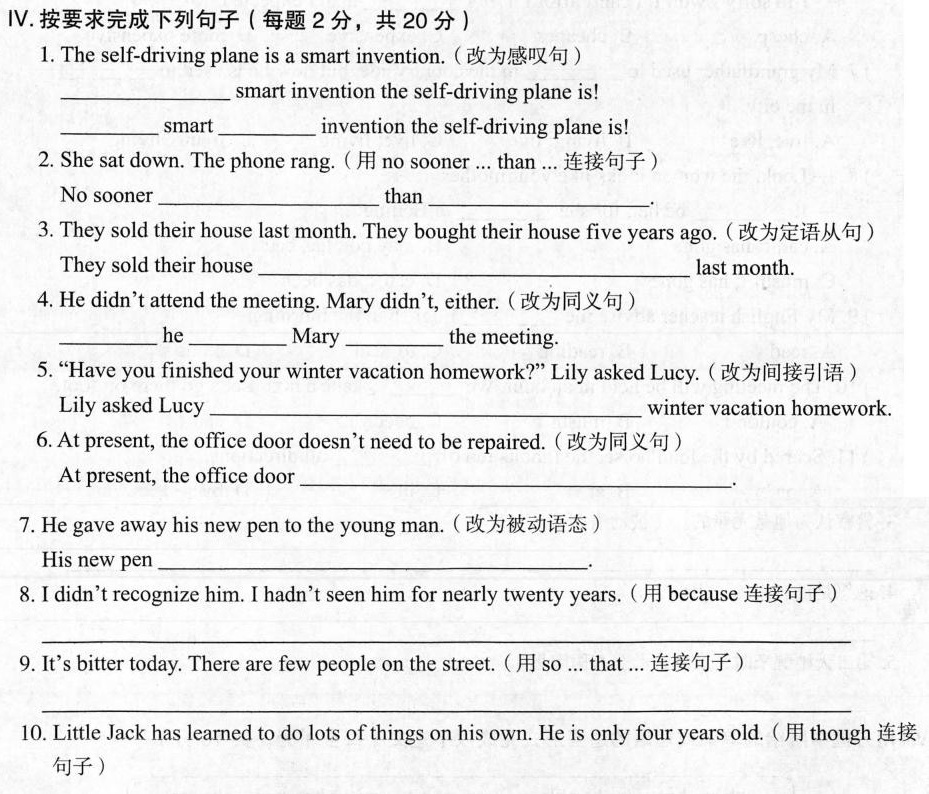
IV.按要求完成下列句子(每题2分,共20分)-|||-1. -duiving plane is a smart invention.(改为感叹句)-|||-__ smart invention the self-driving plane is!-|||-__ smart __ the self-driving plane is-|||-2.She sat down.The phone rang.(用no sooner ...than ...连接句子)-|||-No sooner __ than __-|||-3.They sold their house last month.They bought their house five years ago.(改为定语从句)-|||-They sold their house __ last month.-|||-4.He didn't attend the meeting.Mary didn't, either.(改为同义句)-|||-__ he __ Mary __ the meeting.-|||-5."Have you finished your winter vacation homework?"Lily asked Lucy.(改为间接引语)-|||-Lily asked Lucy __ winter vacation homework.-|||-6.At present,the office door doesn't need to be repaired.(改为同义句)-|||-At present,the office door __-|||-7.He gave away his new pen to the young man.(改为被动语态)-|||-His new pen __-|||-8.I didn't recognize him.I I hadn't seen him for nearly twenty years.(用because连接句子)-|||-9.It's bitter today.There are few people on the street.(用so...that...连接句子)-|||-10.Little Jack has learned to do lots of things on his own.He is only four years old.(用though连接-|||-句子)
题目解答
答案
解析
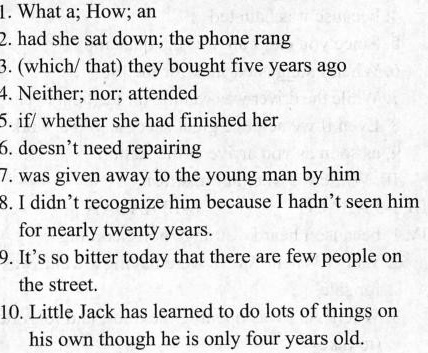
本题主要考查英语句子的不同句式转换,包括感叹句、no sooner...than...连接句子、定语从句、同义句、间接引语、被动语态以及用特定连词连接句子等知识点。解题时需要根据不同的句式要求,运用相应的语法规则进行转换。
- 感叹句转换:
- 对于 “What a/an + 形容词 + 可数名词单数 + 其他成分!” 结构,“smart invention” 是可数名词单数,且 “smart” 发音以辅音音素开头,所以用 “What a”。
- 对于 “How + 形容词/副词 + 其他成分!” 结构,这里强调 “smart” 这个形容词,所以用 “How”。
- 当用 “How + 形容词 + a/an + 可数名词单数 + 其他成分!” 结构时,“invention” 发音以元音音素开头,所以用 “an”。
- no sooner...than...连接句子:
- “no sooner...than...” 表示 “一……就……”,当 “no sooner” 位于句首时,句子要部分倒装,即把助动词、情态动词或系动词提到主语前面。
- 原句 “She sat down” 是一般过去时,借助助动词 “did”,倒装后为 “had she sat down”,“than” 后面的句子用正常语序 “the phone rang”。
- 改为定语从句:
- 先行词是 “their house”,在定语从句中作 “bought” 的宾语,关系代词可以用 “which” 或 “that”,也可以省略。
- 从句 “They bought their house five years ago” 调整为 “(which/that) they bought five years ago” 来修饰先行词 “their house”。
- 改为同义句:
- “neither...nor...” 表示 “既不……也不……”,连接两个并列的主语,谓语动词与靠近的主语保持一致。
- 原句 “He didn't attend the meeting. Mary didn't, either.” 用 “Neither; nor; attended” 来表达相同的意思。
- 改为间接引语:
- 直接引语是一般疑问句,改为间接引语时,用 “if” 或 “whether” 引导宾语从句。
- 直接引语中的一般过去时 “Have you finished” 要变为过去完成时 “had she finished”,人称 “your” 变为 “her”。
- 改为同义句:
- “need to be done” 表示 “需要被做”,其同义结构是 “need doing”,主动形式表示被动意义。
- 所以 “the office door doesn't need to be repaired” 可改为 “the office door doesn't need repairing”。
- 改为被动语态:
- 被动语态的结构是 “be + 过去分词”。
- 原句 “He gave away his new pen to the young man” 中,“His new pen” 是动作的承受者,作主语,“gave away” 的过去分词是 “was given away”,“by him” 表示动作的执行者。
- 用because连接句子:
- “because” 表示 “因为”,引导原因状语从句。
- 把 “I hadn't seen him for nearly twenty years” 作为原因,用 “because” 连接到 “I didn't recognize him” 后面,即 “I didn't recognize him because I hadn't seen him for nearly twenty years”。
- 用so...that...连接句子:
- “so...that...” 表示 “如此……以至于……”,引导结果状语从句。
- “It's bitter today” 是原因,“There are few people on the street” 是结果,用 “so...that...” 连接为 “It's so bitter today that there are few people on the street”。
- 用though连接句子:
- “though” 表示 “虽然,尽管”,引导让步状语从句。
- “Little Jack has learned to do lots of things on his own” 是主句,“He is only four years old” 是让步状语从句,用 “though” 连接为 “Little Jack has learned to do lots of things on his own though he is only four years old”。